You can talk to an AI tutor at 2 a.m., point your phone at a menu and read it, and get a streak reminder before breakfast. But a language takes hundreds of hours, and those hours have to come out of a life that is already full. So the most useful question isn't which app is smartest. It's which one you'll still want to open on a tired Tuesday in month three. That question is why we built Vocabi.
Four good tools, four different jobs
The best language apps of 2026 have each picked a specialty, and all four below are worth your time.
Disclosure: this article comes from the people who make Vocabi, so check each product's own page too.
| Product | Best for | The trade-off | Cost |
|---|---|---|---|
| Duolingo | A short daily habit, built on streaks and milestones | The motivation leans on protecting your streak | Free to start; paid Super and Max tiers |
| Speak | Speaking out loud with an AI tutor and getting feedback | Six courses for English speakers; little outside speaking practice | 7-day trial, then a subscription |
| Anki | Serious flashcard review on your own terms | You supply the cards' purpose and the motivation | Free on desktop and Android; paid on iOS |
| Language Reactor | Dual subtitles and a pop-up dictionary on Netflix and YouTube | Runs on desktop Chrome, not on your phone | Free, with a paid Pro tier |
Prices change often and vary by region, so treat that column as a guide.
What still gets in the way: pressure and scatter
Streaks work, and it would be silly to pretend otherwise. Duolingo reports that learners who reach a 7-day streak are 3.6 times as likely to finish their course. It also says plainly why long streaks hold people: they "practice each day to protect that progress."
But protecting something is a different feeling from looking forward to it. Miss a day during a hard week, and the app you were enjoying can become one more thing you've let slip.
The second problem is scatter. Learn from a show in one tool, review in another, and translate in a third, and your words end up in three places. None of those tools knows what the others taught you.
Vocabi is built to be somewhere you like going back to
Vocabi answers the pressure problem with a place instead of a number. Its tagline is "Where Language Grows," and that turns out to be fairly literal.

Your words rebuild a village
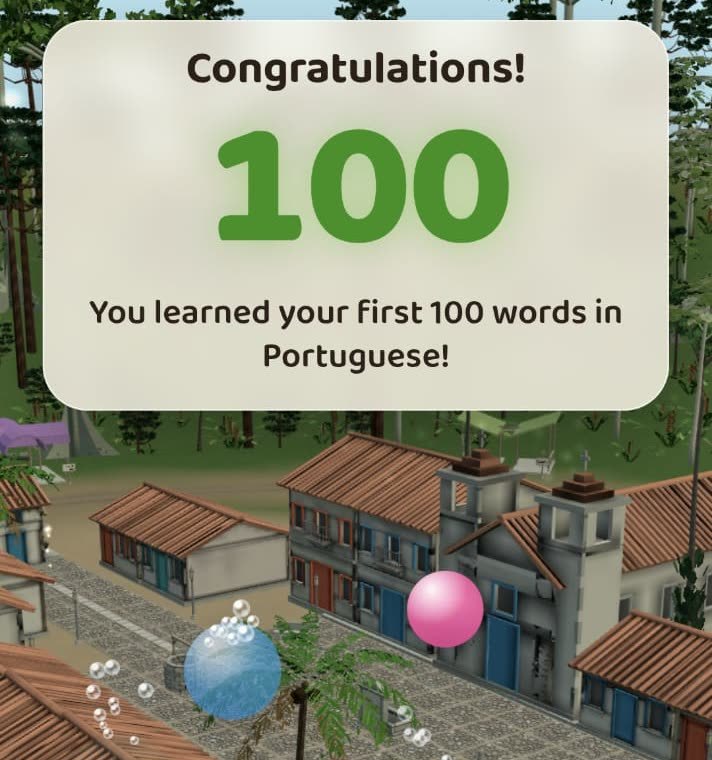
Every language has its own small village, and it starts as ruins. Word games wait in pavilions around the rubble. Each word you learn becomes a brick with that word on its face, and the village rises from piles of rubble to a town with roofs on. Your first 100 words aren't a statistic. You can walk around in them. Start your village at vocabi.ca.
The morning starts with a hello
The first time you open Vocabi each day, it says good morning and uses your name. Then a tear-off calendar shows the date, written in the language you're learning, so even the date is a little vocabulary. Then comes your week, drawn as seven stacks of brick.
Had a quiet week? It tells you so and moves on. There's no empty chart to look at.
The only streak belongs to the word
Vocabi has no daily streak to protect. Its streak applies to a single word: get it right three times in a row, and you've learned it. Three small bubbles fill as you go, and the third one fires a brick. Take a week off and there's no counter to reset.
It knows when to stop
A round of a game ends with an actual ending rather than dealing another board. If you learned new words, you get a small celebration and watch the meter rise. If you didn't, the card simply says "Round complete!", because a "0 words learned" summary would turn a win into a report card.
Reminders work the same way. Vocabi waits until you've practiced before offering one, asks at most twice, and says so up front: "If you are busy, we will ask less often."
Then the world opens up
Finish your first village and a forest opens beyond it. You can walk it, carry things in your pack, and take on errands for the people you meet. Fireflies, falling leaves and snow drift through it. When you have nothing left to do, the journal just says: "Nobody is waiting on you. Go and talk to someone."
Few lines sum up the mood better.
One suite, from your first letter to your favorite show
Vocabi covers the whole road in one account, so a word you meet anywhere ends up in the same deck. That's the fix for scatter, and it's the part no single-purpose tool can offer.
A word you tap in a Netflix subtitle shows up later in a game on your phone. When you learn it, your village grows.
- Letters. Learning Georgian, Russian, Arabic or Armenian? Trace each letter until your hand knows it, then sort letters into jars and write your first real words.
- Seven word games. Matchy, Word Search, Crossword, Lamplight, Word Blocks, Bubbles and Verbacid each drill a different skill, from meanings to verb forms.
- Translator. Type or speak in one language and read it in another, then keep any word you want.
- Reader and stories. Read a story from the shelf or paste any text, and tap a word to see its meaning.
- Browser extension. Tap a word in the subtitles on Netflix, YouTube or Angel. The video pauses, and the line's translation uncovers as you tap the words you didn't know. Here's why it starts covered.
- Yap. Live chat with real people, where every message doubles as a reading lesson.
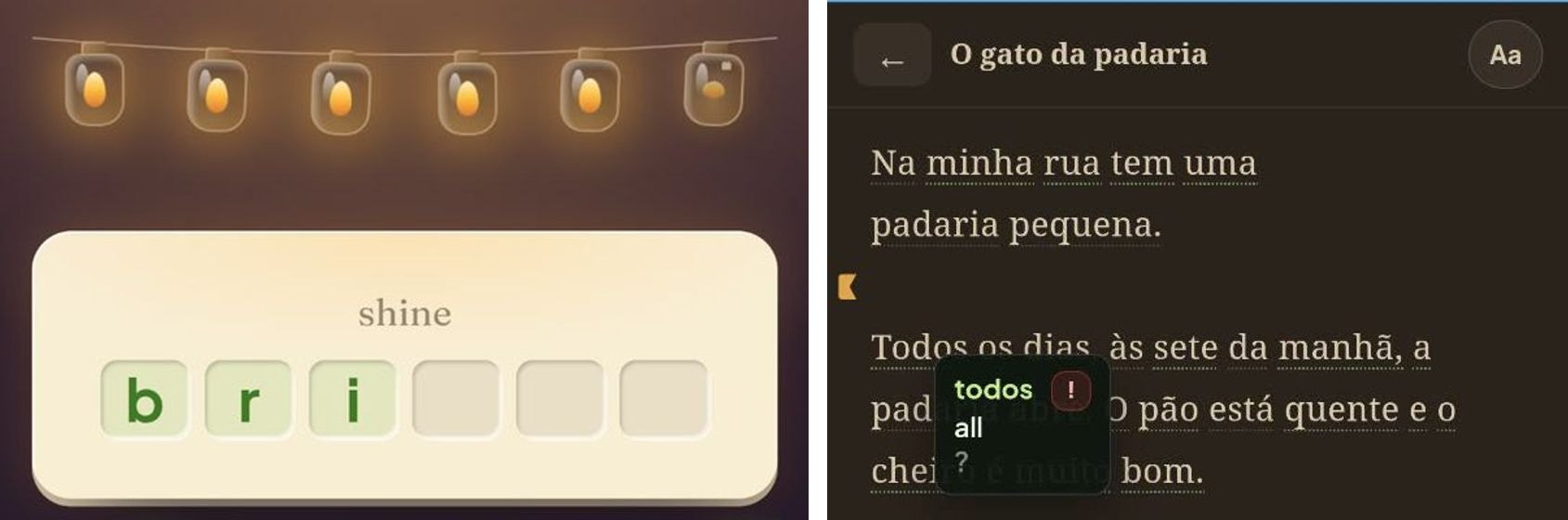
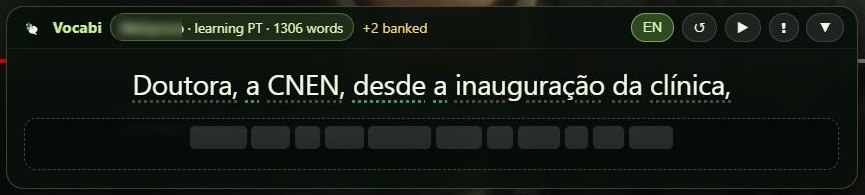
Vocabi teaches 15 languages from English or Portuguese: Portuguese, English, Spanish, French, German, Polish, Romanian, Japanese, Georgian, Armenian, Arabic, Russian, Ukrainian, Serbian and Kyrgyz.
Yap turns a friend into your favorite lesson
AI tutors are endlessly patient, but they will never ask how your sister is doing. Yap is a live chat app for that kind of conversation, with real people, in their language.
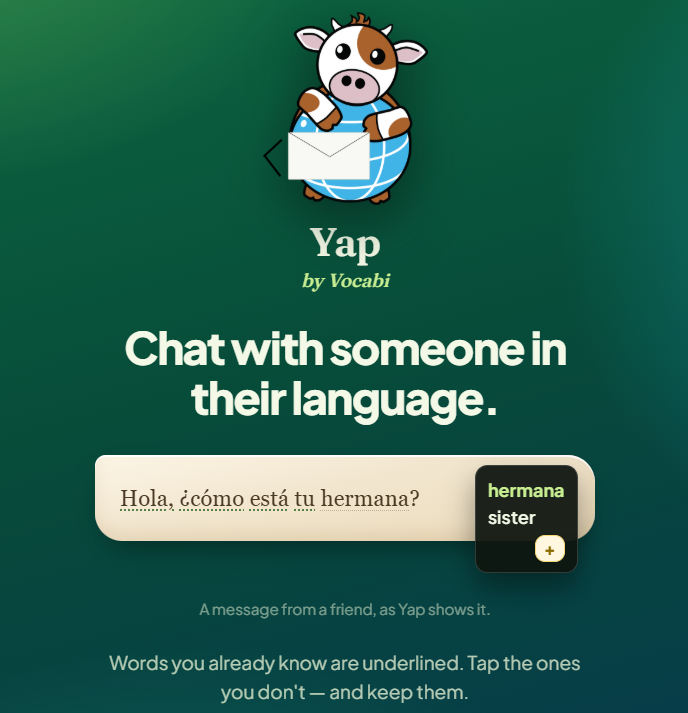
A message arrives, and the words you already know are underlined. Tap one you don't, see what it means, and keep it. It goes straight into your Vocabi deck, because Yap uses the same account. Each message can also show how many of its words you already know, which makes a friend's text a small, friendly measure of your progress.
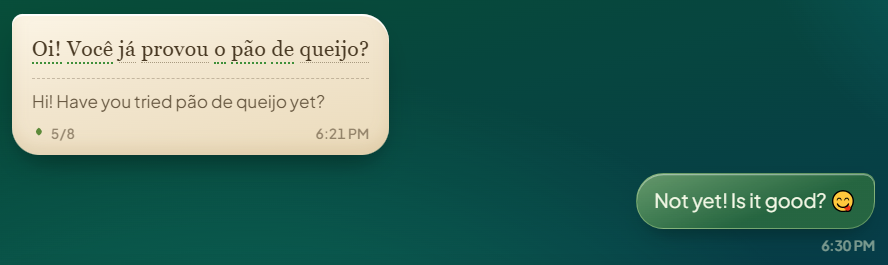
You can invite someone with a link or QR code, even if they don't have an account yet. You can share photos and videos too, and Yap can read and translate the text in a photo. Open it from inside Vocabi, or install it as its own app. Try the sample chat.
Pick the one you'll keep opening
For speaking practice above all, try Speak. If a streak gets you moving and you enjoy that, Duolingo has earned its place. If you want full control of your flashcards, Anki remains hard to beat.
Vocabi is for people who want the language to feel like somewhere to go, with everything in one place. It's also still young, and a few limits are worth knowing:
- The app is on Android and the web. There's no iOS app.
- The browser extension runs on desktop Chrome and is still with a small group of testers. You can sign up to join.
- It's free, and carries light ads in the games and the world. Study tools like flashcards, the Reader and letter tracing stay clean.
- In the forest, an energy bar ends a sitting. The village has no such limit.
If that sounds like your kind of evening, start at vocabi.ca, get Vocabi on Google Play or read more about Vocabi. Start with one letter.
Learning with a friend? See how Yap works, and try the sample chat.
Sources
Checked 5 November 2026. Vocabi details come from the product itself.
- Duolingo: how the streak builds habit (Duolingo's own figures)
- DuolingoGuides: Video Call and Super (third-party, updated July 2026)
- Speak
- Anki
- Language Reactor on the Chrome Web Store
- FluentU: Language Reactor review (last modified May 2025)