Portuguese is a generous language to start. Much of its vocabulary looks familiar if you know any Spanish, French or Latin-rooted English, and its spelling mostly follows rules. Then someone speaks it at normal speed, and the words you could read a minute ago melt into sounds you can't place.
This guide covers who speaks Portuguese, where it comes from, what tends to trip people up, and which tools in Vocabi help with each part.
About 269 million people speak Portuguese
Ethnologue's 2026 figures count about 252 million native speakers and 18 million second-language speakers. That makes Portuguese the eighth most spoken language in the world by total speakers. By native speakers alone, it comes well ahead of French, German and Russian.
It's an official language in nine countries and in Macau, across Europe, South America, Africa and Asia.
Those places are far from equal. Brazil alone holds about 203 million native speakers, so most of the Portuguese you'll hear online is Brazilian. Angola has the next most, ahead of Portugal itself. In several other countries, Portuguese is the language of school and government, and many people grow up speaking something else at home.
| Place | Native speakers | Counted |
|---|---|---|
| Brazil | 203 million | 2022 |
| Angola | 16.7 million | 2024 |
| Portugal | 10.2 million | 2023 |
| Mozambique | 5.3 million | 2020 |
| São Tomé and Príncipe | 153,000 | 2022 |
| Cape Verde | 11,800 | 2016 |
| Timor-Leste | 9,500 | 2022 |
| Macau | 3,800 | 2016 |
| Guinea-Bissau, Equatorial Guinea | No figure found |
From Wikipedia's country table. The counts come from different years and methods, so they won't add up to Ethnologue's total. They also leave out second-language speakers, who are many in countries like Cape Verde and Mozambique.
A Romance language that went its own way
Portuguese is one of the languages that grew out of Latin. The Romans reached Iberia in 218 BC, and over the centuries the Latin spoken in the northwest became Galician-Portuguese, first written down around the 9th century. Portugal became a kingdom in 1143, and the language gradually split from Galician. In the 15th and 16th centuries, traders, missionaries and colonizers carried it to Africa, Asia and the Americas, which is why the map looks the way it does.
Among Romance languages, only Spanish has more native speakers.
Native speakers, in millions. Spanish, Portuguese and French are Ethnologue 2026; Italian and Romanian are Wikipedia's figures. French has far more speakers once you count second languages.
The family resemblance is easy to see, and so is the way Portuguese wore its Latin down. It dropped the l and n between vowels, which is how Latin lunam became lua, dolorem became dor, and manum became mão.
| Portuguese | Spanish | French | Italian | Romanian | |
|---|---|---|---|---|---|
| moon | lua | luna | lune | luna | lună |
| hand | mão | mano | main | mano | mână |
| night | noite | noche | nuit | notte | noapte |
| water | água | agua | eau | acqua | apă |
| son | filho | hijo | fils | figlio | fiu |
Ethnologue puts Portuguese's vocabulary overlap at about 89% with Spanish, 80% with Italian, 75% with French and 72% with Romanian. With English it's about 20%, though English borrowed so much from Latin and French that many words will still look familiar.
If you already speak Spanish, you have a real head start on reading, and a smaller one on listening. In a 1989 study, as summarized by Voigt and Schüppert, Spanish speakers understood about 50% of spoken Portuguese. Brazilians did a little better in the other direction, at about 58%. That was passive listening, without a face or gestures to help.
What people find hard
On paper, Portuguese is one of the easier languages for English speakers. The US Foreign Service Institute puts it in its easiest group, at 24 weeks. But that's about 23 class hours a week, roughly 550 hours in a classroom, to reach professional speaking and listening. Easy is relative. These are the parts that take the time.
The sounds, above all
Portuguese has five nasal vowels and a set of nasal diphthongs, and English has no real match for them. Pão (bread), mãe (mother) and põe (puts) are short words you'll need early, and they're hard to hear and harder to say. Vowels also shift when they're unstressed, so a word you know on paper can sound quite different in a sentence. That gap is why so many learners read far better than they understand.
Choosing Brazil or Portugal
Beginners often worry about this more than they need to. The two remain mutually intelligible, and formal writing barely differs. Speech differs far more. European Portuguese reduces its unstressed vowels much further, and in fast speech they can vanish.
| Brazil | Portugal | |
|---|---|---|
| train | trem | comboio |
| bus | ônibus | autocarro |
| she is dancing | ela está dançando | ela está a dançar |
| you (everyday) | você, or tu in some regions | tu |
Choose the one spoken by the people you want to talk to. If you have no one in mind yet, Brazilian gives you by far the most speakers.
A lot of verb forms
A verb changes for person, tense and mood, and accents matter. If you've studied Spanish, you'll recognize the split between ser and estar, both meaning "to be". Portuguese also has two forms that surprise most learners:
- The personal infinitive. An infinitive that takes a person ending: É melhor voltares, "It's better that you go back."
- The future subjunctive. Uncommon among related languages, and it often follows se (if): Se cantarmos, seremos pagos, "If we sing, we'll be paid."
Small marks and false friends
A small mark can change the word. Avó is your grandmother and avô is your grandfather. Pais are your parents and a país is a country. Little words also fuse together: de + o becomes do, and em + a becomes na.
Then there are the words that lie. Puxar sounds a bit like "push" and means "pull". Pretender means "to intend". Esquisito means "strange", which catches Spanish speakers, since exquisito means "exquisite" or "delicious".
How Vocabi helps with Portuguese
Disclosure: this part is about our own product. It's written by the people who make Vocabi, and the limits are listed further down.
Vocabi teaches Portuguese with a Brazilian setting and defaults. It's free on Android and the web, and every tool feeds the same deck of words.
A Brazilian village, for your first 100 words
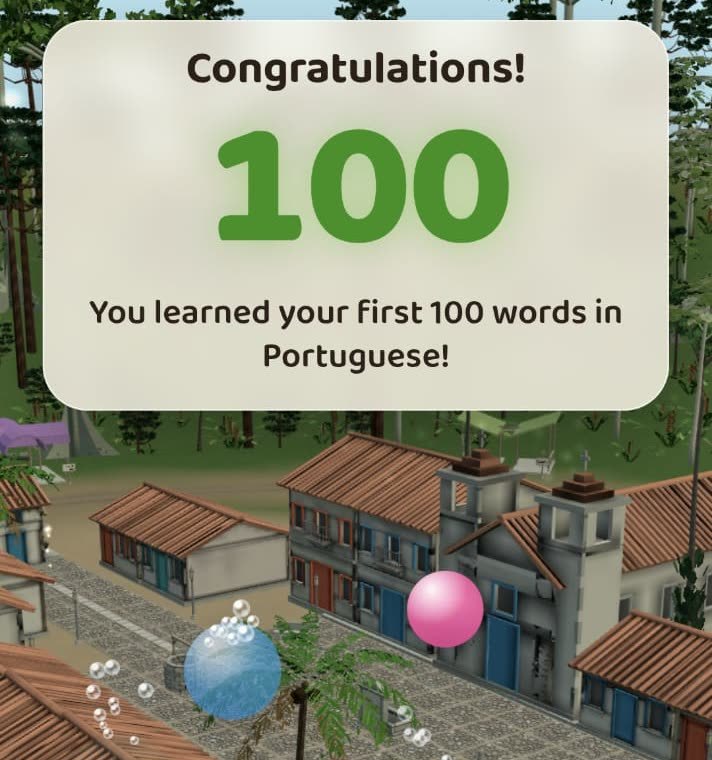
Your first stop is a ruined Brazilian village in the Atlantic forest. As you learn words, its 25 buildings rise from heaps of brick to finished homes with roofs, and the square gets paved in Portuguese-style stone.
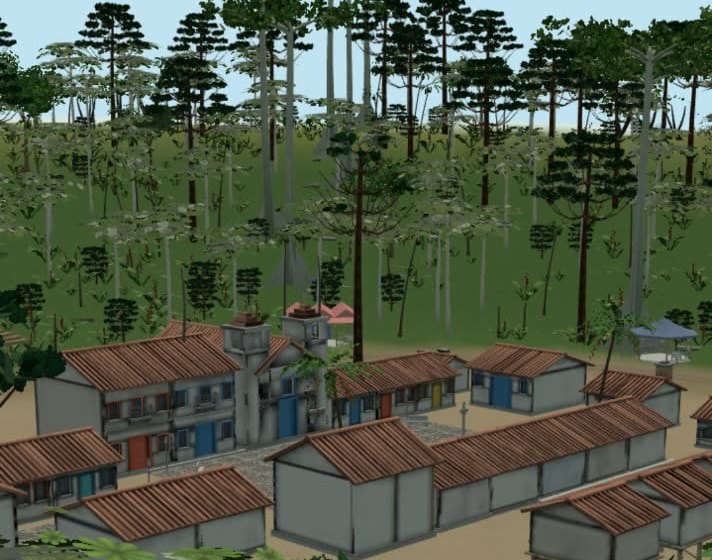
The 100 words are a curated list of common words, in frequency order. You start with ten, then get five a day. A word counts as learned when you get it right three times in a row. Reach 100 and the wider world opens, and your words come with you.
Games that take accents seriously
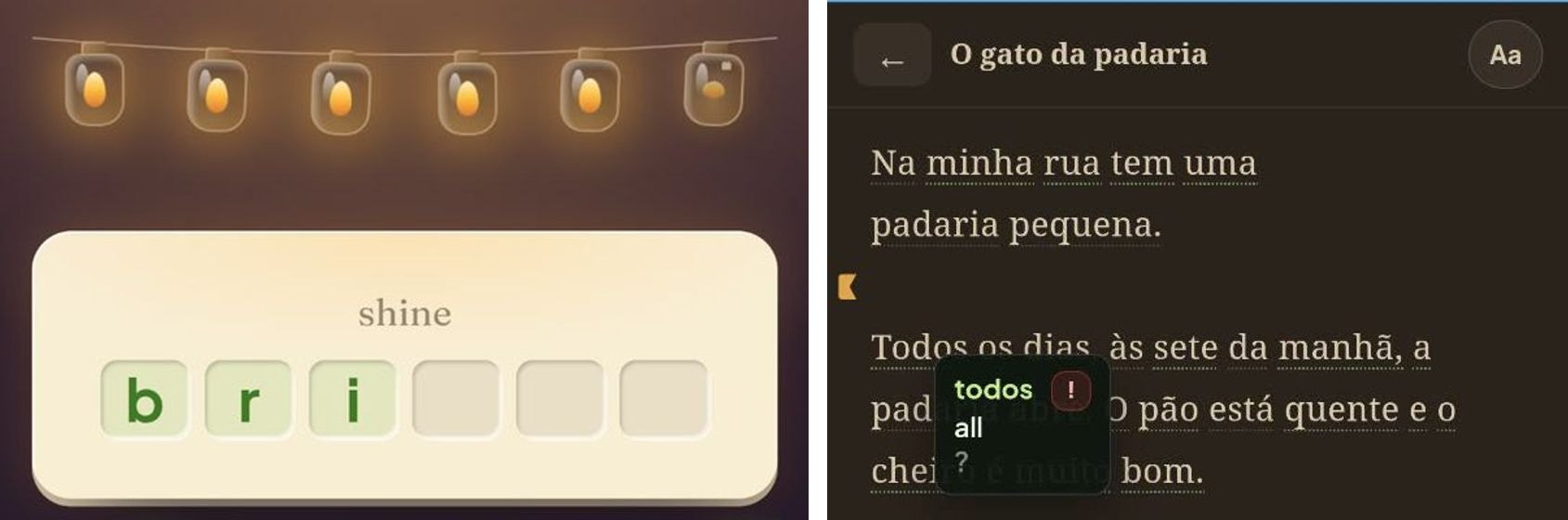
Since one mark can change the word, the spelling games don't let it slide. Lamplight gives ã, ç, é and the other accented letters their own tiles, and it won't accept a plain letter in their place. In Word Search, é and e are different letters. Crossword spells ç as its own letter too.
Matchy pairs words with meanings, Word Blocks builds translations of whole sentences, and Bubbles and Coin Count work on numbers.
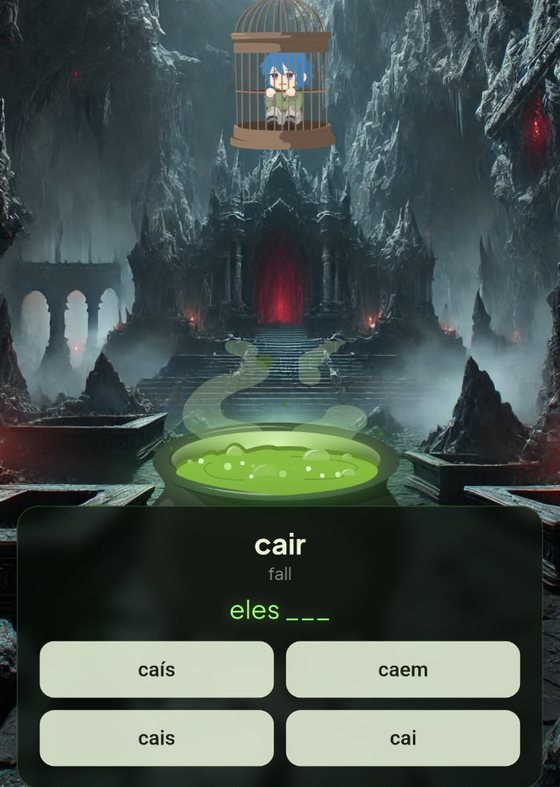
Verbacid and Fill the Blank, for the verbs
Verbacid shows you a verb and a person, then gives you four forms of that same verb to choose from. So eles + cair means picking caem out of cai, cais and caís. It drills the present tense across all six persons. Fill the Blank then asks for a verb form inside a sentence.
Reader, stories and Translator
The Reader has three very short Portuguese stories: O gato da padaria and Sábado na feira at A1, and A raposa e as uvas at A2. You can also paste in any text. Tap a word to see its meaning and keep it.
The Translator turns what you type or say into Portuguese, and you can keep any word from the result. On a device with a Portuguese voice installed, it can read the result aloud, so you can hear those nasal vowels on demand. It's machine translation, so treat it as a helper rather than the final word.
Real speech: the extension and Yap
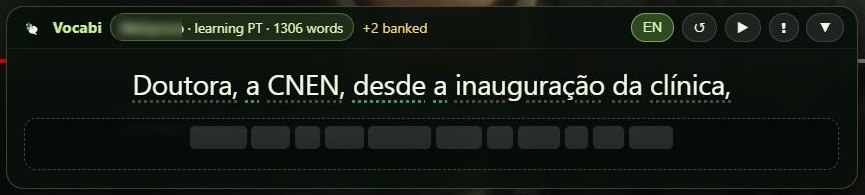
The sound problem takes real listening. The Vocabi browser extension works on Portuguese subtitles on Netflix, YouTube and Angel. Tap a word and the video pauses, and the translation below stays covered until you've earned it. It runs on desktop Chrome and is still with a small group of testers, so you sign up to join.
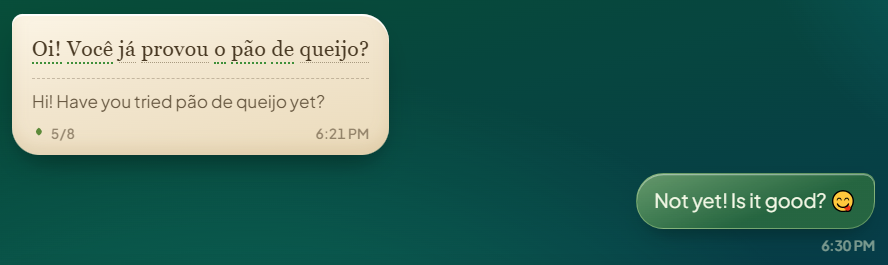
Yap is live chat with people you know. With 252 million native speakers out there, you may well have a friend, a neighbor or an in-law to message. Every word you keep from a chat lands in the same deck.
Where Vocabi falls short for Portuguese
- It's stronger on reading and spelling than on hearing. The stories have no audio, and the number games are silent for now. Since sound is the hardest part of Portuguese, pair Vocabi with shows, music and real people.
- It doesn't teach European Portuguese. The setting and defaults are Brazilian. If you're moving to Lisbon, you'll want a source from Portugal as well.
- The verb drills are narrow, and not fully Brazilian. Verbacid covers the present tense only. It also drills tu and the old vós forms, and it has no separate você row. Você takes the same form as ele, so you still practice it.
- The story shelf is small. Three short stories won't last long, though the Reader takes any text you paste in.
- There's no iOS app. Vocabi is on Android and the web. It's free, with light ads in the games and the world.
If that sounds like your kind of evening, read more about Vocabi, start at vocabi.ca, or get it on Google Play.
Still comparing? See how to choose a language app in 2026.
We post short language history on Instagram too: @vocabi_grove.
Sources
Checked 5 November 2026. Details of Vocabi come from the product itself. Example words and false friends are standard usage.
- Wikipedia: languages by total speakers (Ethnologue 2026 figures)
- Wikipedia: geographical distribution of Portuguese speakers
- Wikipedia: Romance languages
- Wikipedia: history of Portuguese
- Wikipedia: lexical similarity (Ethnologue values)
- Wikipedia: Portuguese phonology
- Wikipedia: Portuguese grammar
- Wikipedia: Brazilian Portuguese
- US Department of State: foreign language training
- Voigt and Schüppert (2013), summarizing Jensen (1989), Hispania 72